
Vietnam chemical import regulations 2026 introduced a new regulatory framework for foreign businesses. It
affects foreign manufacturers, traders and Vietnamese foreign-invested
companies that import, distribute, store or use industrial chemicals,
solvents, raw materials and chemical mixtures.
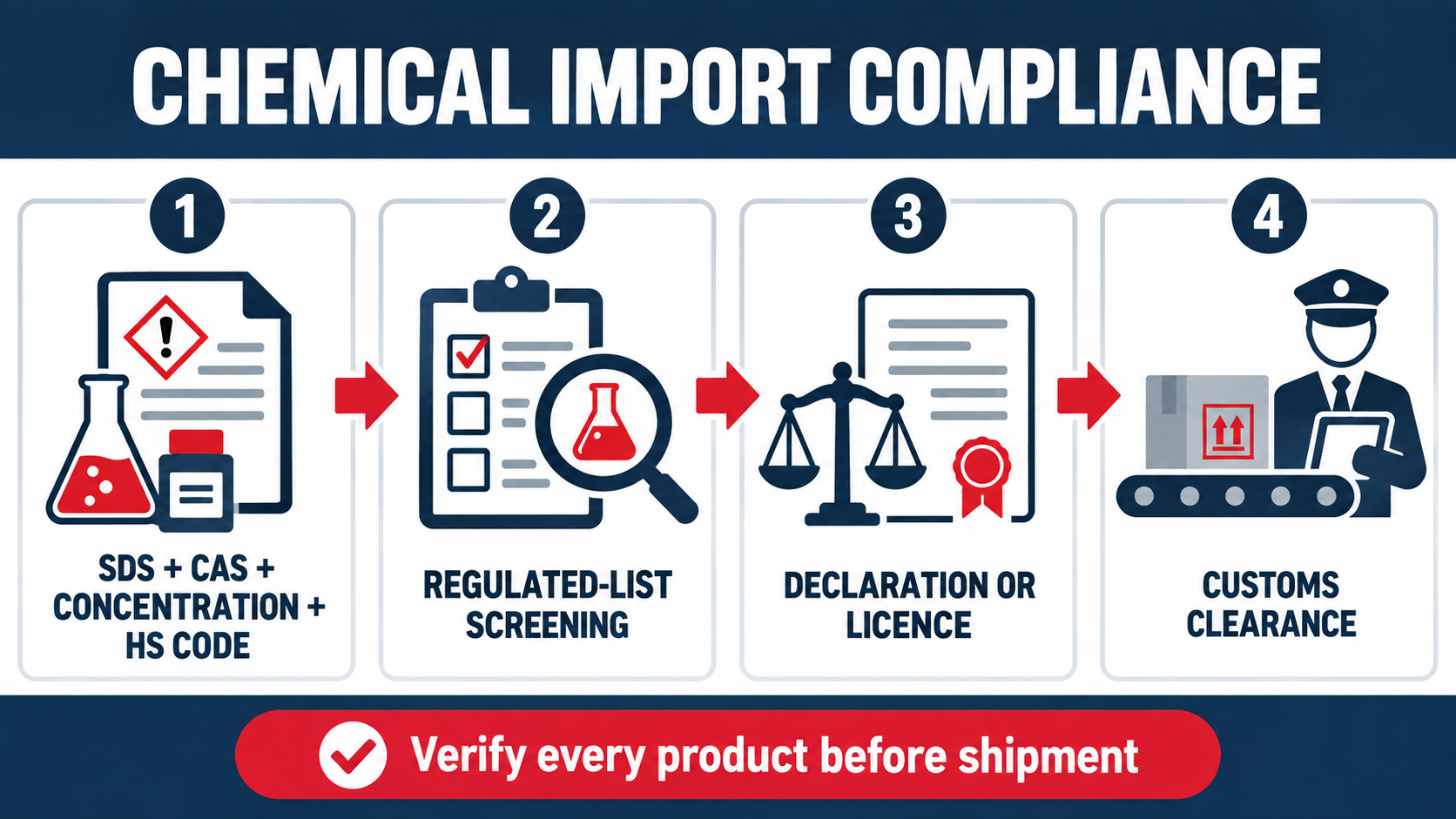
The most important compliance lesson is simple: a commercial product
name is not enough. Before a shipment is booked, the importer should
identify the substance or mixture by its chemical name, CAS number,
composition, concentration and proposed HS code. Those details determine
whether an import declaration, licence, certificate, new-chemical
registration or other control applies.
Vietnam’s Law
on Chemicals No. 69/2025/QH15 took effect on 1 January 2026. The
Government and Ministry of Industry and Trade then issued three decrees
and two circulars forming the principal implementation package. The
Vietnam Chemicals Agency has also formally
requested businesses to implement the new rules.
The 2026 Chemical
Regulatory Framework
The main instruments relevant to an industrial chemical importer
include:
- Decree
No. 24/2026/ND-CP, which sets out the regulated chemical lists; - Decree
No. 25/2026/ND-CP, concerning chemical-industry development and
chemical safety and security; - Decree
No. 26/2026/ND-CP, concerning chemical activities and hazardous
chemicals in products and goods; - Circular
No. 01/2026/TT-BCT, providing forms and detailed guidance under
Decree 26; and - Circular No. 02/2026/TT-BCT, providing detailed measures under
Decree 25.
The decrees and circulars were issued on 17 January 2026. Companies
should replace legacy checklists based only on the former chemical
framework with a review under the 2026 legislation.
The Government later issued Resolution
No. 19/2026/NQ-CP on 29 April 2026 to reduce, decentralize and
simplify certain Ministry of Industry and Trade procedures and business
conditions. A filing should therefore be prepared against the rules in
force on the filing date, including applicable simplifications.
Step
1: Identify the Chemical Before Classifying the Legal Requirement
Foreign suppliers commonly use a brand or internal code such as
“PC-505” or “PD-555.” The Vietnamese authority cannot classify a product
from that name alone.
The importer should obtain:
- The chemical or product name;
- The CAS number of each relevant substance;
- The full composition or a legally sufficient composition
disclosure; - The concentration of controlled or hazardous ingredients;
- The physical form and intended use;
- The proposed HS code;
- The country of origin and manufacturer; and
- A current Safety Data Sheet.
For a mixture, the analysis may depend on both the identity and
concentration of its components. A pure substance and a formulated
product containing that substance may also follow different customs and
chemical-control routes.
The importer should not rely exclusively on an overseas supplier’s HS
code or an English-language SDS. Customs classification, regulated-list
screening and safety documentation serve different purposes and should
be reconciled before shipment.
Step
2: Screen the Product Against Vietnam’s Chemical Lists
Decree No. 24/2026/ND-CP contains the lists used by the new Law on
Chemicals. Depending on the product and activity, a chemical may fall
into categories including:
- Chemicals subject to conditions for production or trading;
- Chemicals requiring special control;
- Chemicals subject to chemical-incident prevention and response
planning; or - Other restricted or prohibited categories governed by the Law and
sector-specific rules.
List screening should use the CAS number and relevant concentration,
not just a similar trade name. The company must then connect the result
to the proposed activity. Importing, selling, storing and using the same
chemical may trigger different requirements.
A foreign-owned company should also confirm that its Enterprise
Registration Certificate, Investment Registration Certificate where
applicable, registered business lines, premises and operational
arrangements support the intended chemical business.
Step
3: Determine Whether an Import Declaration Is Required
Under Decree No. 26/2026/ND-CP, an organization or individual
importing chemicals classified in Chapters 28 or 29 of Vietnam’s import
and export tariff nomenclature must generally submit an import chemical
declaration through the Vietnam National Single Window before customs
clearance.
The decree provides exemptions, including certain cases
involving:
- Specially controlled chemicals already covered by an import
licence; - Prohibited chemicals already covered by a competent authority’s
import licence; - An imported quantity below 10 kilograms;
- Less than 1 kilogram of a new chemical imported for testing and
assessment of physicochemical properties; and - Certain mixtures outside Chapters 28 and 29 that contain chemicals
classified within those chapters.
An exemption from the import declaration is not necessarily an
exemption from all chemical, customs, safety, labelling or licensing
duties. For example, a specially controlled chemical may be exempt from
the declaration precisely because it is already managed under a separate
import-licensing route.
The importer should preserve the declaration result and the documents
supporting any claimed exemption in the shipment file.
Step
4: Check Whether a Separate Licence or Eligibility Certificate Is
Needed
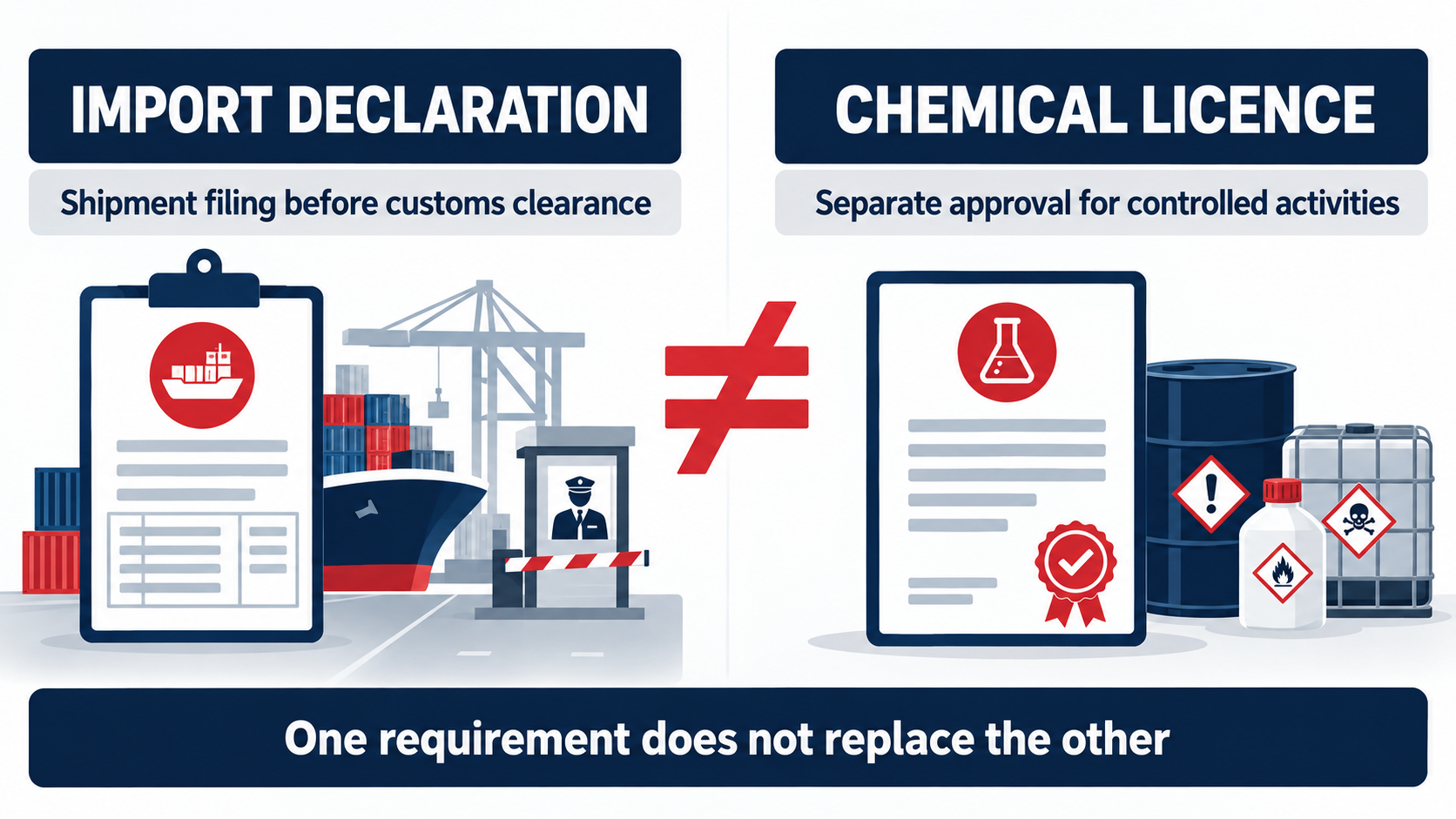
An import declaration is different from a licence.
Where a chemical is subject to special control, the business may need
a licence for the relevant production, trading, export or import
activity. Chemicals subject to conditional trading may require the
company to hold an eligibility certificate and comply with requirements
concerning premises, equipment, safety management and qualified
personnel.
The correct procedure depends on:
- The regulated list and concentration;
- Whether the company imports for its own use or for resale;
- Whether it stores or repackages the chemical;
- The proposed facility and warehouse;
- The personnel responsible for chemical safety; and
- The intended end use.
Companies should also check the procedural changes under Resolution
No. 19/2026/NQ-CP rather than assuming that every document or condition
in an older licence checklist remains unchanged.
Step 5: Review New-Chemical
Status
Under the 2026 Law, a new chemical is generally a substance that does
not appear in Vietnam’s National Chemical Inventory or in a foreign
chemical inventory recognized by the competent Vietnamese authority.
A new chemical may only be used or placed on the market after
registration with the competent authority, unless a statutory exemption
applies.
This review is especially important for:
- Proprietary additives;
- Newly developed industrial substances;
- Imported research materials that may later be commercialized;
and - Mixtures whose supplier does not fully disclose the identity of an
ingredient.
A supplier statement that a substance is “already registered
overseas” is not sufficient by itself. The Vietnamese importer should
confirm the relevant inventory and whether Vietnam recognizes it for
this purpose.
Step 6:
Prepare Classification, Labels and Safety Data Sheets
The Law requires manufacturers and importers to classify and label
chemicals before they are used or placed on the market. Classification
follows the Globally Harmonized System of Classification and Labelling
of Chemicals, together with Vietnamese implementing rules.
An importer of hazardous chemicals must prepare the required Safety
Data Sheet and is responsible for the information it contains. A seller
of hazardous chemicals must provide the Safety Data Sheet to the
buyer.
Before customs clearance or local distribution, the company should
review:
- Vietnamese product and chemical-labelling requirements;
- GHS hazard classes, pictograms and signal words;
- The Vietnamese-language information required for local users;
- Consistency between the label, SDS, invoice, packing list and
declaration; - Emergency contact and first-aid information; and
- Storage incompatibilities and transport precautions.
Simply translating an overseas SDS without checking the composition,
legal references and local responsible entity can create
inconsistencies. The Vietnamese importer should control the final
document used in Vietnam.
Does
a Bonded Warehouse or Re-Export Plan Remove the Requirements?
Not automatically.
A bonded warehouse, temporary import for re-export arrangement or
logistics provider may affect the customs treatment and the point at
which goods enter the Vietnamese market. It does not by itself answer
every chemical-law question.
The parties should identify:
- Who is the importer of record;
- Which customs regime will be used;
- Whether the chemical will remain under customs supervision;
- Whether any portion may be released into the domestic market;
- Who operates the warehouse;
- Whether repacking, sampling or processing will occur; and
- Who is responsible for labels, SDS, emergency response and
regulatory records.
The contract should allocate these responsibilities clearly. A
foreign supplier should not assume that the customer, customs broker or
warehouse will complete chemical compliance unless the scope is
expressly agreed and verified.
Storage,
Training and Incident-Response Obligations
Import approval is only one part of compliance. A company storing or
using hazardous chemicals may also need to address:
- Suitable premises and chemical-compatible storage;
- Separation of incompatible substances;
- Safety equipment and warning signs;
- Chemical-safety training and records;
- Internal handling and inventory controls;
- Fire prevention and environmental requirements; and
- Measures or plans for chemical-incident prevention and
response.
The applicable level depends on the chemical, quantity, facility and
activity. The company should review the warehouse before the first
shipment, not after the goods arrive.
Where a third-party warehouse is used, the importer should obtain and
verify the operator’s relevant corporate documents, eligibility records,
safety procedures and contractual responsibility for incidents.
Hazardous Chemicals
in Products and Goods
The 2026 framework also addresses hazardous chemicals contained in
products and goods. A company should not assume that chemical regulation
ends once a substance is incorporated into a formulated product or
finished item.
Depending on the product, chemical and concentration, disclosure,
information, declaration or record-keeping duties may apply.
Sector-specific rules for products such as pesticides, disinfectants,
cosmetics, food-related goods, medical products or industrial materials
may also operate alongside the general chemical law.
The importer should therefore conduct both:
- A chemical-substance review; and
- A product-specific regulatory review.
Enforcement Risk
Increased in August 2026
Decree
No. 275/2026/ND-CP, issued on 8 July 2026, took effect on 25
August 2026 and governs administrative penalties in the
chemicals and industrial-explosives sectors.
Depending on the violation, consequences may include monetary
penalties and additional sanctions or remedial measures, such as
suspension of activities, loss of the right to use a licence or
certificate, confiscation and required correction of non-compliant
conduct.
For foreign-owned companies, an enforcement issue can also interrupt
customs clearance, production and customer deliveries. Pre-shipment
classification is normally less costly than correcting the importer,
licence, label or warehouse arrangement after the goods reach
Vietnam.
Practical Pre-Shipment
Checklist
1. Obtain Technical
Information
Collect the SDS, CAS numbers, full composition, concentration,
intended use and proposed HS code.
2. Screen Every Substance
Check the 2026 chemical lists and any sector-specific controlled
lists. Do not screen only the principal ingredient.
3. Confirm the
Importer and Customs Regime
Identify the entity named on the declaration and determine whether
the goods will enter domestic circulation, a bonded warehouse or a
re-export procedure.
4. Determine the Filing Route
Confirm whether the shipment needs an import declaration, a separate
licence, a new-chemical registration or evidence supporting an
exemption.
5. Review the Vietnamese
Entity
Check the ERC, IRC where applicable, business lines, premises,
warehouse, personnel and required eligibility certificates.
6. Finalize Labels and SDS
Make the GHS classification, Vietnamese information and shipment
documents consistent before dispatch.
7. Prepare Safety Controls
Confirm storage compatibility, training, emergency equipment and
incident-response obligations.
8. Preserve a Compliance File
Keep the classification analysis, list-screening result,
declarations, licences, SDS, labels, contracts and customs documents for
each product and shipment.
Common
Mistakes Made by Foreign Suppliers and Importers
Businesses should avoid:
- Classifying a product only by its commercial name;
- Using an HS code supplied overseas without a Vietnamese review;
- Treating an import declaration as a substitute for a licence;
- Assuming a small concentration can be ignored without checking the
legal threshold; - Shipping before confirming new-chemical status;
- Using an untranslated or outdated foreign SDS;
- Assuming a bonded warehouse eliminates all chemical
obligations; - Leaving compliance entirely to a customs broker; or
- Using a checklist based solely on the pre-2026 legislation.
How TICA TrustLegal Can
Assist
TICA TrustLegal supports foreign chemical suppliers, importers and
foreign-invested companies with:
- Product-by-product chemical classification and regulated-list
screening; - Review of CAS numbers, concentrations, SDS and proposed HS
codes; - Chemical import declarations and exemption assessments;
- Applications for chemical licences and eligibility
certificates; - New-chemical registration assessments;
- Vietnamese labels and Safety Data Sheet compliance;
- Review of bonded-warehouse, re-export and local-distribution
structures; - Company formation, IRC/ERC amendments and business-line review;
and - Ongoing chemical, customs, corporate and safety compliance
coordination.
Before dispatching a chemical shipment to Vietnam, send TICA
TrustLegal the SDS, composition, CAS numbers, proposed HS code, quantity
and intended use. We can identify the likely filing route and missing
documents before the goods reach customs.
Hotline/WhatsApp: +84 354 658 272
Email: tica.trustlegal@gmail.com
Website: www.ticatrustlegal.com
This article reflects the legislation and official materials
available as of 21 September 2026. Chemical classification and licensing
depend on the exact substance, concentration, use, quantity, entity and
customs arrangement. This article is general information and does not
constitute legal advice for a specific shipment.


